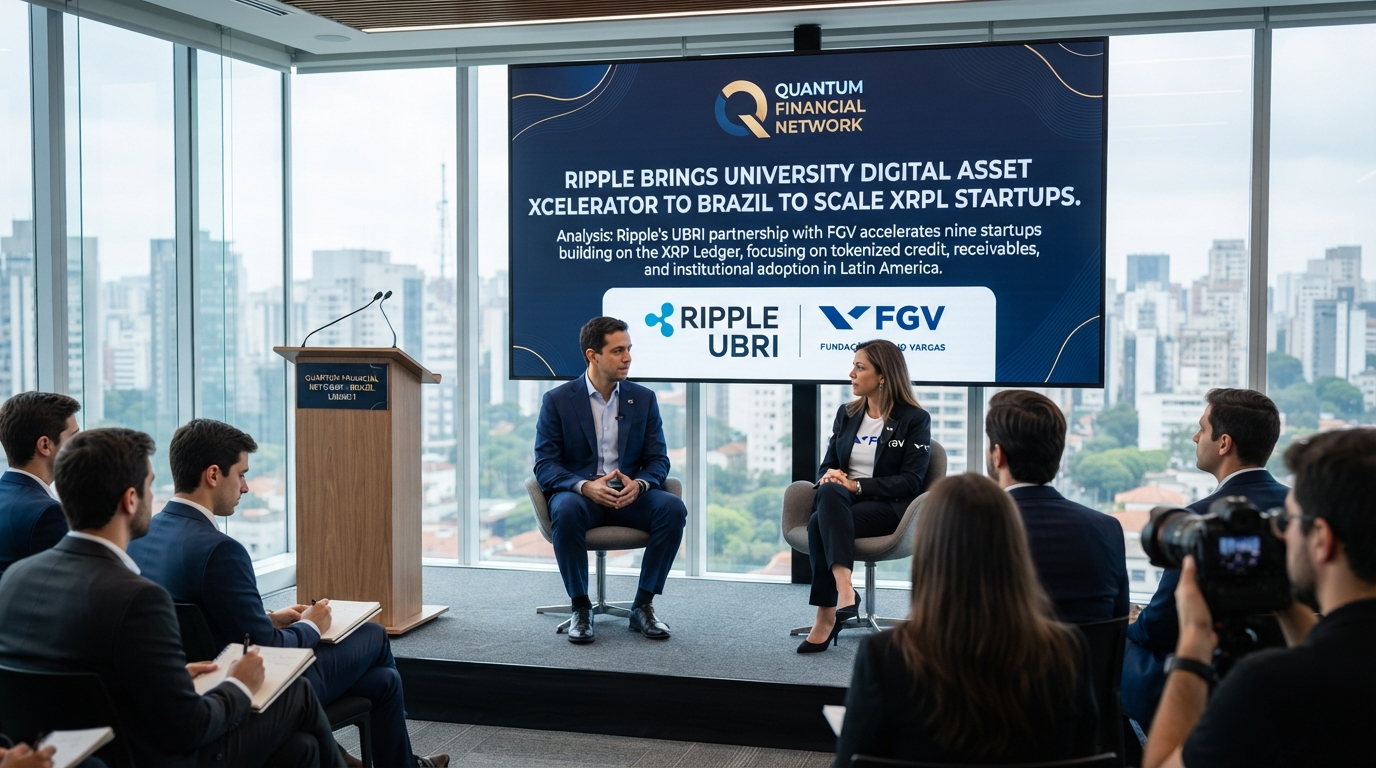
Ripple Brings University Digital Asset Xcelerator to Brazil to Scale XRPL Startups
Ripple has brought its University Digital Asset Xcelerator (UDAX) to Brazil for the first time, establishing a structured bridge between academic research and commercial blockchain infrastructure. Conducted as a partnership between Ripple’s University Blockchain Research Initiative (UBRI) and Fundação Getulio Vargas (FGV), the eight-week acceleration program supported nine early-stage startups developing technical applications on the XRP Ledger (XRPL).
The initiative highlights how enterprise-backed academic networks are attempting to accelerate commercial maturity in Latin America’s digital asset sector. By pairing institutional researchers with market-focused builders, UDAX targets specific real-world use cases, including tokenized credit, cross-border settlement rails, and regulated financial infrastructure.
---
Bridging Academic Rigor and Market Execution
The UDAX program was designed to move academic exploration closer to production-ready deployments. Over the course of eight weeks, participating founders received specialized mentoring, technical resources, and strategic connections from Ripple, global UBRI network participants, and academic experts from FGV and the University of California at Berkeley.
The curriculum featured business seminars led by faculty members and industry specialists, including FGV Center for Digital Finance Professors Jéfferson Colombo and Fernando Chague, alongside University of São Paulo (USP) Professors Marcos Simplício and Leandro Maciel. Mentorship was further supported by FGV EESP, FGV Ventures, and FGV Crypto.
According to Lauren Weymouth, Senior Director of University Partnerships at Ripple, the primary differentiator of the cohort was its focus on practical utility.
> "What stood out in this cohort wasn't just the technology but it was who it serves. Tokenized credit for family farmers, transparent rails for social-impact donations, infrastructure that brings more institutions into regulated digital finance," Weymouth noted.
Post-program survey data released alongside the initiative indicate measurable growth across participating entities. Startups reported an average 83% increase in product maturity and a 53% rise in investment readiness. Additionally, founders noted an average 33% increase in business model confidence and a 15% expansion in active users or paying customers. A Demo Day held on FGV’s campus brought together approximately 100 stakeholders, including investors, entrepreneurs, academics, and regional fintech participants.
Jéfferson Colombo, Director of FGV Digital Finance and professor at the São Paulo School of Economics of FGV, emphasized the structural gap the program aims to address. "Academic research on digital assets has been moving slower than the market it studies. UDAX closes that gap by putting our faculty and Brazil's most promising founders in the same room to turn rigorous research into real companies."
---
Cohort Breakdown: Real-World Applications on the XRPL
The nine participating startups utilized the UDAX framework to refine products spanning institutional stablecoin deployment, fixed-income tokenization, cross-border corridors, and agricultural microcredit:
* **Levery** (led by Cristiano Policarpo and Ingrid Gomes): Established a sandbox environment enabling financial institutions to experiment with Ripple USD (RLUSD), XRPL liquidity features, permissioned pools, institutional wallets, swaps, and tokenized asset infrastructure. The platform engaged eight participating institutions, generated over 44,000 onchain transactions, and expanded its client base from seven to twelve organizations during the eight-week program. * **Kapitale** (founded by Anderson Pereira): Formulated a structured roadmap for receivables tokenization and blockchain transaction recording, focusing on increased transparency, programmability, and scalability within Brazil’s receivables financing market. * **VS1 Finance** (created by Nikoloz Beradze and Mikheil Didebulidze): Refined its strategy for bringing corporate bonds onto distributed ledgers within central bank-supervised frameworks. Operating across a target regional market spanning Georgia, Central Asia, and the Gulf—part of an estimated $100 billion annual bond issuance market—VS1 was cited in Messari’s *State of XRP Q1 2026* report. The firm has completed a central bank-approved platform demo ahead of a scheduled Q3 2026 regulated real-world asset (RWA) issuance. * **BillPay** (led by Glaucio Silva, Daniel Franco, and Rosangela Doehl): Pivoted from a generalized international payments model to specialized collection and settlement infrastructure operating directly between Brazil and Paraguay, validating its operational strategy and partnership network. * **TrustBond** (founded by Luiz Calado, Rafaela Ferrari Kley, Rogério Nahas, and Marina Miranda): Enhanced its donation traceability platform, finishing the accelerator with seven active pilot projects with third-sector organizations and over €1 million in requested donations. * **PixNow** (led by Victor Cunha and Bruno Ventura): Focused on go-to-market execution and client communications, growing its client roster from 12 to 17 organizations. * **Regolda** (founded by Daniele and Isaac Kielmanowicz): Developed its positioning for public gold-backed tokens on the XRPL, securing new partnerships within precious metals and blockchain markets. * **Lendara** (led by André Rodrigo Meira e Silva): Collaborated with legal mentors to navigate regulatory compliance for blockchain-based microcredit and barter transactions targeting family farming and agribusiness. * **C9 Tech** (founded by Thiago Chaves Ribeiro, Marcos Portes, Matheus, Arthur Gomes, and Helio Rosado Neto): Entered the program already operating on the XRPL Mainnet with 12 corporate clients, using the accelerator to scale its fundraising narrative across payments and tokenized assets.
---
Market Implications and Outlook
QFN analysis indicates that programs like UDAX serve as early indicators of institutional pipeline development in emerging markets. By embedding startups within academic networks and regulatory-compliant sandboxes, Ripple and its academic partners are attempting to systematically reduce friction for enterprise adoption of the XRPL.
The emphasis on stablecoin liquidity experimentation—demonstrated by Levery’s sandbox transactions—and regulated fixed-income tokenization points to a broader industry shift toward permissioned and compliant public-ledger applications. As these nine startups transition from acceleration to active market deployment, the scalability of their respective regulatory frameworks and institutional partnerships will dictate their long-term viability within Latin America's evolving digital finance infrastructure.
---
Source Read the original report from [Ripple Insights](https://ripple.com/insights/ripple-launch-university-digital-asset-xcelerator-udax-in-brazil/).